
Customer service: 00971581607579 📞


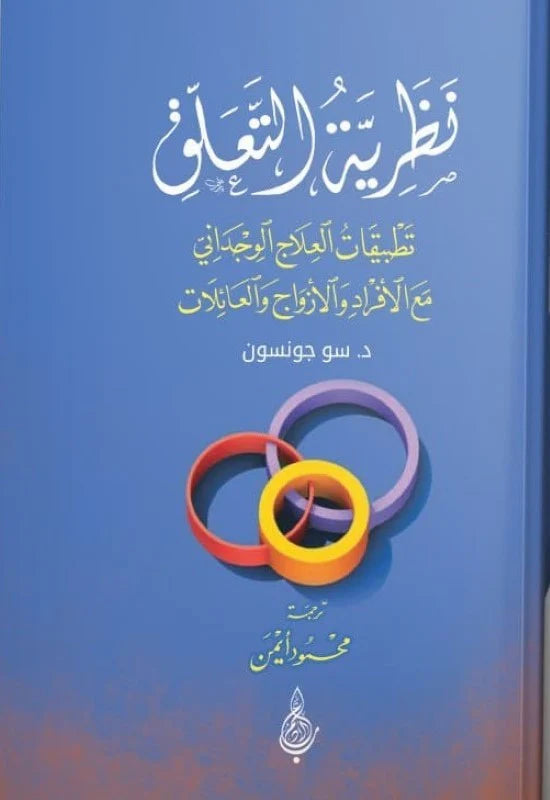
Attachment theory
Applications of emotional therapy with individuals, couples, and families
Author Name: Dr. Sue Johnson
Modern attachment theory was developed by the genius John Bowlby (1969, 1973, 1980, 1988), and its first model was developed by modern social psychologists (Cassidy and Shaver 2008, Mikulniker and Shaver 2016). What are the principles of the modern theory?
There are three general facts to be aware of.
First: The basis of attachment theory is relational, meaning that it views the individual in the context of his closest relationships with others, and it depicts him as essentially a social being who creates bonds with others; a creation that is, in reality, the most important means for human beings to survive.
The second fact is that the theory is concerned with emotions and their regulation. It pays special attention to fear, not just everyday fears, but also existential fear, which reflects fundamental issues such as feelings of helplessness and weakness. This, in turn, reflects fears of death, isolation, loneliness, and loss. The most important thing for a person's well-being and mental health is: Can these factors be addressed in a way that improves resilience and increases vitality?
The third fact is that this theory is evolutionary, meaning it is concerned with individual development and the factors that facilitate or hinder adaptation. The theory believes that intimate relationships with trusted individuals create the most suitable environment for the development of the human mind, nervous system, and basic behavioral patterns, and represent the appropriate context for optimal development.
• Attachment theory is an evidence-based evolutionary theory that studies personality and prioritizes the role of emotion regulation and connection with trusted individuals, making this a core component of mental health and well-being.
The greatness of this perspective lies in its connection between interaction and biology, between mental model and message, between self and method, and in its identification of the most important human needs and fears.
It also answers the eternal burning question: What is love and why is it so important?

Best Selling

All blue sky
All the Sky is Blue Author Name: Melissa da Costa Emile, a 26-year-old, has been diagnosed with early-onset Alzheimer's. Doctors estimate his memory won't last more than two years. Emile decides to embark on one last journey, fleeing the hospital and the...
- Dhs. 75.00
- Dhs. 75.00
- Unit price
- per

The disease and the cure known as the sufficient answer for those who ask about the healing medicine
The disease and the cure known as the sufficient answer for those who ask about the healing medicine Author's name: Ibn al-Qayyim al-Jawziyya In this book, Ibn al-Qayyim addresses the issues of the human soul and its roles, and outlines ways to reform and...
- Dhs. 49.00
- Dhs. 49.00
- Unit price
- per


I loved and tomorrow I will recover from toxic relationships
I Loved a Scoundrel Recovering from Abusive Relationships Author Name: Dr. Emad Rashad Othman We always wait for someone. We think that with their arrival, all our pains will vanish. We delude ourselves into believing that with their light shining on the...
- Dhs. 35.00
- Dhs. 35.00
- Unit price
- per


Texts of the student of knowledge
Texts of the Student of Knowledge | Abdul Mohsen bin Muhammad Al-Qasim Scientific texts verified based on 120 manuscripts Level One: The Nullifiers of Islam, the Four Principles, the Forty-Three Fundamentals, and the Forty-Three Hadiths of Nawawi Level Two: The Beqouni System, The Children’s...
- Dhs. 42.00
- Dhs. 42.00
- Unit price
- per


Explanation of the Forty Nawawi Hadiths
Explanation of An-Nawawi's Forty Hadiths Author: Muhammad ibn Salih al-Uthaymeen An-Nawawi's Forty Hadiths is a compilation containing forty noble prophetic hadiths, collected by Imam An-Nawawi, who committed himself to ensuring their authenticity. An-Nawawi explained his reason for compiling the forty hadiths, stating:...
- Dhs. 57.00
- Dhs. 57.00
- Unit price
- per


Taysir Al-Karim Al-Rahman in interpreting the words of Al-Mannan, Al-Saadi’s interpretation
Taysir al-Karim al-Rahman fi Tafsir Kalam al-Mannan (The Facilitation of the Most Gracious, Most Merciful in the Interpretation of the Words of the Beneficent) - Tafsir al-Sa'di Author's name: Sheikh Abdul Rahman bin Nasser Al-Saadi Al-Sa'di's interpretation is one that focuses on clarifying the...
- Dhs. 73.00
- Dhs. 73.00
- Unit price
- per


17 x 24 Tajweed Quran divided into 4 parts size
The Tajweed Quran, divided into 4 parts, measuring 17*24 cm According to the narration of Hafs from Asim - in the Uthmani script - and three main colors and with the direct application of 28 rulings This complete Tajweed Quran is divided into four...
- Dhs. 135.00
- Dhs. 135.00
- Unit price
- per


Tajweed Quran, translation of the meanings of the Quran into English with Roman script, size 17*24 cm
Tajweed Quran with English translation of the meanings of the Quran and Roman script The Tajweed Quran with English meanings and Roman numeral translation, along with a subject index. The English translation is by Abdullah Yusuf Ali, and the audio translation is by Subhi...
- Dhs. 155.00
- Dhs. 155.00
- Unit price
- per
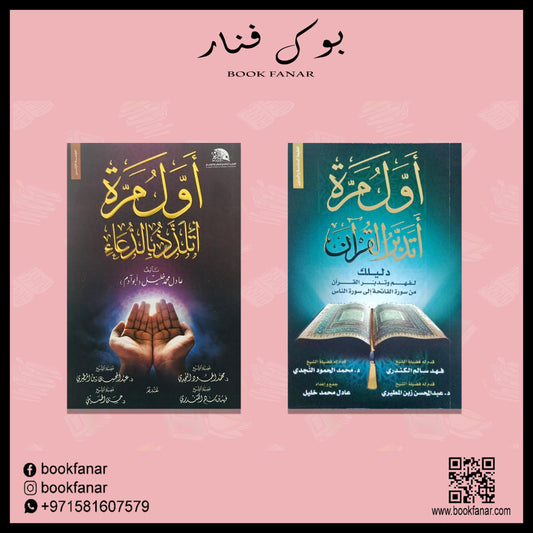

The first time I contemplated the Qur’an - The first time I enjoyed supplication
Islamic Group - Gifts and Distributions First time I reflect on the Quran This is the first time I've truly enjoyed praying. Presented by: Abdulmohsen Zain Al-Mutairi, Fahad Salem Al-Kandari, Mohammed Al-Hamoud Al-Najdi Prepared by: Adel Mohamed Khalil Your guide to understanding and reflecting...
- Dhs. 75.00
Dhs. 95.00- Dhs. 75.00
- Unit price
- per

Explanation of the Three Fundamentals by Sheikh Al-Uthaymeen
Explanation of the Three Fundamentals Author's name: Muhammad ibn Abd al-Wahhab Explanation of Sheikh Al-Uthaymeen An explanation of the treatise (The Three Fundamentals) by Sheikh al-Islam Muhammad ibn Abd al-Wahhab, may God have mercy on him (d. 1206 AH). These fundamentals are the servant’s...
- Dhs. 27.00
- Dhs. 27.00
- Unit price
- per
- Choosing a selection results in a full page refresh.