
Customer service: 00971581607579 📞


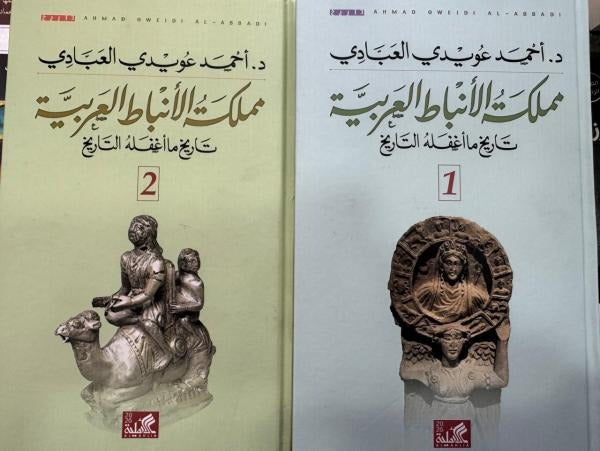
The Arab Nabataean Kingdom: A History Overlooked by History
Author's name: Ahmed Owaidi Al-Abadi
This work constitutes an unprecedented qualitative addition to Arab and international studies concerned with the history of the Nabataeans and their Jordanian kingdom, as it redraws their civilizational image away from reductionism, distortion, and prevailing Orientalist interpretations, presenting a new comprehensive reading of the period extending from 450 BC to 106 AD.
This book comes with a deep analytical approach that does not merely narrate or repeat, but rather deconstructs old, orientalist and foreign narratives, and rereads them in light of Jordanian geography, archaeological data, linguistic connotations, and social and political structures, to present new scientific results and conclusions that previous studies have not reached.
The author has addressed the subject of the Nabataeans from multiple and intertwined angles, combining history, anthropology, sociology, law, language, astronomy, political economy, identity, legitimacy, and nationalism, in an integrated encyclopedic approach.
The book proves, with coherent scientific argument, that the Nabataeans were Thamudic Arabs of Jordanian origin, whose existence dates back thousands of years as a cohesive tribe, arising within a cultural context connected to the ancient Jordanian kingdoms, particularly the Hurrian and Edomite kingdoms. The Nabataeans began as nomadic pastoralists and Bedouin tribes who practiced herding.
They then excelled in trade, renting out camels for caravans, and protecting their routes, which gave them deep expertise in geography, economics, and human movement. Over time, they settled in Petra under the protection and banner of the Edomite Kingdom of Jordan, continuing the traditions of rock carving that were begun by the Hurrians and developed by the Edomites, until they reached their artistic and cultural zenith in the Nabataean era.
The author pays special attention to the legal-civilizational dimension of the Nabataean state, highlighting that it was a sophisticated kingdom in the concept of justice and the judiciary, and that the Nabataeans established an advanced judicial system that reached the point of creating what can be considered a Court of Cassation or Appeal in the modern institutional sense, which is a legal achievement that precedes many modern judicial systems in the East and West.
The author, Dr. Ahmed Owaidi Al-Abadi, devoted a lengthy chapter to analyzing the judicial decisions of their supreme courts, demonstrating their accuracy, fairness, sound logic, and moral excellence, and comparing them to contemporary judicial systems in countries where the judiciary operates with absolute freedom, concluding that they surpass modern systems in essential aspects in terms of accuracy, fairness, consistency, and methodology.
The book also reveals that the Nabatean Arab Thamudic people of Jordan were pioneers in pivotal cultural and linguistic fields, as it shows that they were the first to invent popular Arabic poetry that is still alive today in what is known as Nabati poetry, and that they developed the Arabic alphabet which later settled into its known form in the modern era, making them a pivotal link in the history of the Arabic language and its written development.
The author does not stop there, but highlights the genius of the Nabataeans in astronomy and water engineering, explaining that they reached high levels of accuracy and innovation in observing the stars, organizing time, and creating complex water systems that were able to tame the harsh environment and transform the desert into a flourishing urban space, with achievements that are still a source of wonder to this day.
With this comprehensive approach, the book “The Arab Nabataean Kingdom” does not merely present a historical study, but rather establishes an authentic Jordanian-Arab reading of a state that played a pivotal role in the history of the Arab East and the European West. It restores the Nabataeans to their rightful place as a Jordanian Thamudic Arab nation that contributed to building civilization, language, law, and science, and established a legacy that is still alive in the conscience and culture of the region to this day. Their human extensions are still present in the contemporary Jordanian tribes, whether some of them realize this connection or not.
The book is also distinguished by its presentation of several new intellectual theories that represent a qualitative renewal in Arab thought and in the reading and interpretation of history. Among the most prominent of these theories is the author's comprehensive foundational scientific theory, which refutes the notion of "Semitism" as an imported and ambiguous linguistic-ethnic classification, and proposes instead the "Thamudic theory" as the most accurate and profound framework for understanding the linguistic and cultural roots of the region's peoples.
This theory stems from a coherent historical, linguistic, and geographical reading that traces the history of the Arab-Jordanian presence back more than fourteen thousand years, and reveals the interconnectedness of the ancient Jordanian kingdoms – from Berea, Edom, Bashan, Moab, Ammon, and Balama to the Nabataean kingdom – within a single, continuous civilizational context, based on historical continuity and local roots, not on imported Orientalist classifications.
From this standpoint, the book “The Arab Nabataean Kingdom” is inseparable from the Jordanian narrative project established and adopted by Dr. Ahmed Owaidi Al-Abadi, and it forms a central link in it, as it re-establishes the Nabataeans in their natural Jordanian context, and proves that the Nabataean state was not a transient or incidental entity, but rather a continuous civilizational and sovereign extension within the Jordanian geography, in which the elements of identity, legitimacy, nationality, language, system, justice, and knowledge were embodied.
Thus, this book becomes a solid scientific testimony that the Jordanian narrative is as old as the land and the Jordanian people, and that rereading it today is not a new invention, but rather a restoration of historical and epistemological rights, and a correction of a long path of exclusion and marginalization that Jordanian history has been subjected to in imported and incoming narratives.

Best Selling


Easy Memorization Quran
Easy Memorization Quran
An innovative method to facilitate memorization of the Holy Quran using verbal and conceptual links.
Mohamed Elsayed Madi, Ahmed Issa Elmasrawi
- from Dhs. 45.00
- from Dhs. 45.00
- Unit price
- per


Tajweed Holy Quran, 30 parts, with an Arabic leather bag, size 17 x 24 cm
Tajweed Quran, 30 parts, with leather case - Arabic Size 24*17 cm This deluxe Tajweed Quran is a paperback divided into thirty separate parts, all presented in a beautiful, sturdy black leather case, perfectly designed to protect the parts from loss or damage. It...
- Dhs. 94.00
- Dhs. 94.00
- Unit price
- per


Taysir Al-Karim Al-Rahman in interpreting the words of Al-Mannan, Al-Saadi’s interpretation
Taysir al-Karim al-Rahman fi Tafsir Kalam al-Mannan (The Facilitation of the Most Gracious, Most Merciful in the Interpretation of the Words of the Beneficent) - Tafsir al-Sa'di Author's name: Sheikh Abdul Rahman bin Nasser Al-Saadi Al-Sa'di's interpretation is one that focuses on clarifying the...
- Dhs. 73.00
- Dhs. 73.00
- Unit price
- per
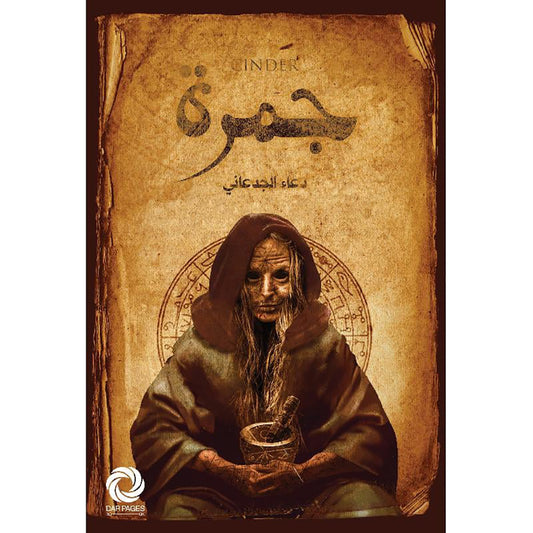

Ember - Duaa Al-Jadaani
cinder
Author's name: Duaa Al-Jadaani
They are cowards, cowards who are good at creating illusions.
- Dhs. 72.00
- Dhs. 72.00
- Unit price
- per


Take your belief from the Qur’an and the authentic Sunnah
Take your belief from the Qur’an and the authentic Sunnah Author's name: Muhammad ibn Jamil Zeno A message from Sheikh Muhammad Jamil Zeno in which he explains the doctrine of the Sunnis and the community on various doctrinal issues: monotheism, polytheism, tyranny, following the...
- Dhs. 15.00
- Dhs. 15.00
- Unit price
- per

Granada Trilogy
Granada Trilogy Author: Radwa Ashour The Granada Trilogy is a series of three novels by the Egyptian author Radwa Ashour, consisting of Granada Mariam Departure The events take place in the Kingdom of Granada after the fall of all Islamic kingdoms in Al-Andalus. The...
- Dhs. 55.00
- Dhs. 55.00
- Unit price
- per


The Qiyam Mushaf with thematic division of the verses of the Holy Quran, white paper, size 24 x 17 cm
The Qiyam Quran with thematic division of the verses of the Holy Quran, white paper, size 24 x 17 cm With Q barcode This Quran is distinguished by having a code on each of its pages. When reading the code using a barcode reader...
- Dhs. 35.00
- Dhs. 35.00
- Unit price
- per

I loved him, so everything loved me back.
I loved him so everything loved me Author's name: Raghad Al Saleh A profound, beautiful book with diverse presentations, ideas, and titles full of benefit and stories taken from the righteous predecessors and their hidden worship and how we get closer to God. I...
- Dhs. 49.00
- Dhs. 49.00
- Unit price
- per


My first stories about God's prophets and messengers
My first stories about God's prophets and messengers A series of stories for children in early childhood education, featuring the prophets and messengers of God Almighty in a simple, enjoyable, and engaging style. The aim is to present lessons and morals drawn from their...
- Dhs. 165.00
Dhs. 185.00- Dhs. 165.00
- Unit price
- per


Azar, son of the Wolf of the Valley
AZAR
Son of the Valley She-wolf
Author: Ahmed Al Hamdan
I dreamt that I gave birth to a moon ascending to the sky, illuminating the Arabian Peninsula with its light.
- Dhs. 79.00
- Dhs. 79.00
- Unit price
- per
- Choosing a selection results in a full page refresh.